The Industrial Scribe · the tools
Agentic AI:
Visualize to Persuade.
You bring the facts, in order. The agent sorts them, picks how to show them, and builds it.
I need one more planner from January.
Who decides?
The plant manager. HR must agree.
What does the plant manager believe today?
"Better discipline, not more people."
Here is who is watching, and what each one believes today.
Ask before the meeting: "What would you need to see?"
Running the calculator script
The gap costs RM 8,100 a month.
RM 4,500 ÷ RM 8,100: the planner pays for itself if 56% of the gap closes.
Building deck-one-more-planner.html
Checking its own work before you send it
✓The ask is in the first line
✓The boss's belief is answered with a test
✓The careful case is shown too
✗No decision date yet. I will not invent one.
✗8 gaps marked [CHECK] to fill before sending
Let's practise. I will play the plant manager.
"We just need better discipline."
Your answer, tightened:
"Fair. The two planners already work about RM 1,800 of overtime a month, and engineers fill 60 hours on top. Let's agree a number: if freight and engineer hours don't fall by March, we stop."
You bring the facts, in order.It sorts them, picks how to show them, and builds it.
Get it USD 9.99 onceIn a free AI chat it guides you step by step, and you build the slides yourself.
Works as a full AI agent in Claude Code. Works as a step-by-step AI guide in any free chat.
Want the real story of how this was built inside a factory? Get the case study too →
Not just how to show it. What to show, and who it is for. It finds who decides, works out the numbers, builds the deck, checks its own work, then plays your boss so you can practise. Written from a career in factory sales and customer-facing roles, getting proposals and plans through management.
Want the detail? Open any part.
The moment this is for
You have a good idea: a new machine, one more planner, a better process, a price increase the customer must accept. You spend two days on the slides. The GM says "okay, noted" and nothing happens. The idea was fine. The ask was not built for the person who decides.
Most chart tools start with the chart. This one starts with two questions: who is watching, and what do you need them to decide? Only then does it pick the chart, the title and what to leave out. It covers proposals, investment plans and business plans too, not only slides.
What it does
- Maps who really decides. Who signs, who can quietly block it, who must live with it, and what each one gains, fears and believes today.
- Does the money maths from your numbers. Payback, return, the cost of waiting, break-even, with every assumption in one table and a conservative case, so the finance manager cannot tear it apart. Missing figures are marked [CHECK], never invented.
- Answers the six approver questions before they are asked. Why this, why now, why this option, how much and when do we get it back, what could go wrong, what exactly do you need from me.
- Builds the options. Do nothing, a small step, the full fix, with one recommended and a stop point that makes the yes feel safe.
- Prepares you for the room. The 5 hardest questions with short answers, and the number most likely to be challenged.
- Writes it. A one-page memo, an email or a short deck, with titles that say what to conclude, not what the slide is about.
- Rehearses with you. It plays your GM or your customer, asks the hard questions, then tightens your answers.
Nine ready layouts
Investment proposal · business plan · budget or headcount ask · new process or system · customer price increase · recovery plan · monthly management review · customer business review · quality update.
Still in the box: slides and the so-what dashboard
- Deck: takeaway titles, the right chart for each factory message with a chart chooser, the ask on its own slide.
- So-what dashboard: an ACT TODAY band with at most three things that crossed your own action rules, every tile with what to do, who does it and by when; grey by default, colour only where action is needed.
- Check: paste a proposal, slide or chart you already made and get the fix.
- A 22-point pre-ship check before anything goes to someone who decides.
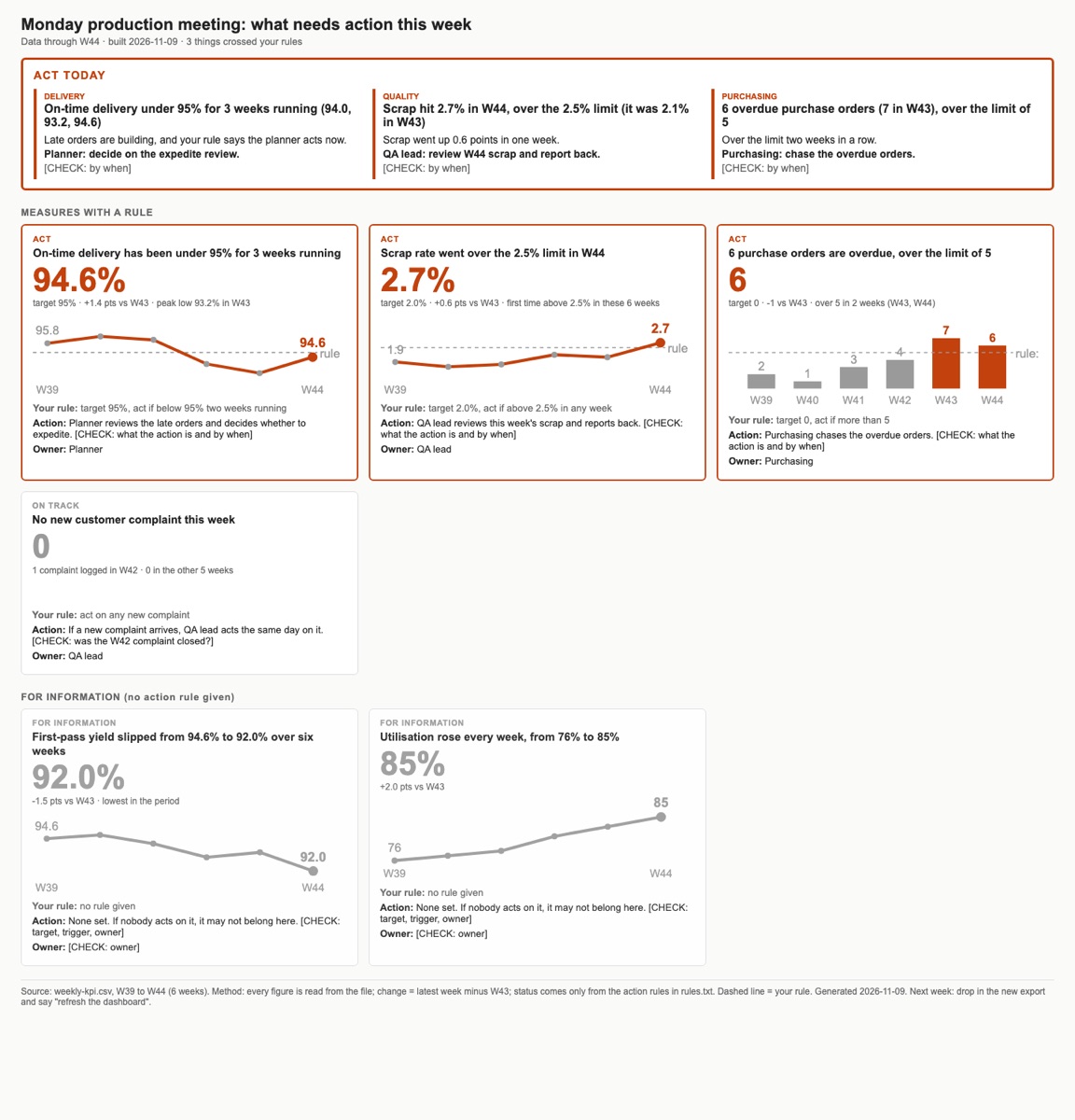
Why we call it an agent
In Claude Code it does not just answer. It works through the job:
- It plans the steps and asks you one question at a time for what is missing.
- It uses real tools: it opens your Excel or CSV and does the maths with a calculator script, never by eye.
- It builds the real thing: a deck or dashboard file that opens in any browser and prints to PDF.
- It checks its own work against 22 points before you send it, and marks every gap [CHECK].
- It plays your boss and asks the hard questions, so you can practise.
The decision, and the send button, stay yours. In a free AI chat it is a step-by-step guide: you paste, it asks and drafts, and you build the slides yourself.
Two ways to run it
A · No install, any AI chat
Open paste-prompt.md, choose proposal, deck, dashboard, check or rehearse, fill the blanks and send. Free plans work.
B · Claude Code skill
For people who already use Claude Code (needs Claude Pro, USD 20/month). Move the visualize-to-persuade folder to your skills folder, drop in your Excel or CSV and say "help me get this approved" or "build my dashboard". It does the maths with a script, never by eye.
What's inside the download
paste-prompt.md: the no-install version.SKILL.md: the Claude Code skill.references/: the playbook itself, seven files: the persuasion method, the nine ask layouts, numbers that persuade, a chart chooser for factory data, takeaway-title formulas, answers to the hard questions, and the pre-ship checklist. Worth reading on its own.examples/: a deck from a messy defect log, a so-what dashboard and the file the skill built, and a headcount proposal from first question to the memo's first line. Invented data, labelled EXAMPLE.
The honest limits
- It uses only your numbers. It will not invent a saving, a target, an owner or someone's opinion, and it will tell you if your case does not add up.
- It makes your case clearer and harder to argue with. It cannot make a bad idea good, and the decision is still the decider's.
- Tested in role-play runs, not with paying customers yet. Follow your company's rules on putting work data into AI tools; placeholders for names and money figures work just as well.
No refund guarantee: it is a download you keep, so read the honest limits above first. After payment you land on your download page; bookmark it. Stuck? Reply to your receipt and a human answers, usually within a day. Back to the solutions →